Konstantin Semenenko
July 8, 2026
3
minutes read
Often, yes, and the 2026 evidence is piling up: heavy agentic setups can run tens of thousands to $300,000+ a year in compute, comparable to a mid-level developer, and public reports show large companies pulling back after token bills hit around $2,000 per engineer per month. But the real trap is subtler. Most teams pay twice, for the tokens and for the humans who still monitor, correct, and review what the agent ships. The right question is not "is AI cheaper than a person," it is "does the agent do a person's worth of work end to end." Today, mostly not, unless you engineer it to.




The honest answer to whether AI agents already cost more than the humans they were meant to replace is: in a lot of real deployments, yes, and the gap is not hidden anymore. Public 2026 reporting is full of it: companies exhausting annual AI budgets in a few months, internal token bills reaching around $2,000 per engineer per month, and analyses putting heavy agentic compute at $60,000 to $300,000 a year per intensive setup, the range of a real developer's salary. But the number on the invoice is only half the story. The deeper problem is that most teams pay twice, once for the tokens and once for the humans who still babysit the agent's output. So the useful question is not the cost of the agent versus the cost of a person. It is whether the agent does a person's worth of work, start to finish, without a person redoing it. This is where that actually lands in 2026.
I'm writing this from the engineering side, because we run agents at real volume, including a single run that billed over $300,000, and the lesson is not "agents are too expensive." It is that cost is something you design, and most teams have not designed it yet.
The evidence that agents can cost as much as the people they replace is no longer anecdotal. Independent analysis puts a serious agentic-development setup at roughly $60,000 to $90,000 a year in real compute for a heavy user, and extreme always-on agentic workflows in the $300,000 range annually, comparable to a mid-level or senior developer. Public reporting through 2026 backs the pattern: Fortune and others documented a major software company moving engineers off a leading coding agent by mid-2026 after token billing reportedly reached about $2,000 per engineer per month, and a large rideshare company was reported to have burned its entire annual AI coding budget in four months.
Our own experience is the sharp end of this: a single run that billed $303,030 in 29 days. The point of citing these together is not that agents are doomed. It is that "an agent is basically free compared to a salary" is a 2024 assumption, and the 2026 invoices have retired it. Agentic workflows use far more tokens per task than a chatbot, 10 to 50 times more, because they plan, call tools, retry, and re-read a growing context on every step, so the cost scales with how much the agent does. A more useful agent costs more, and the bill has no ceiling unless you set one.
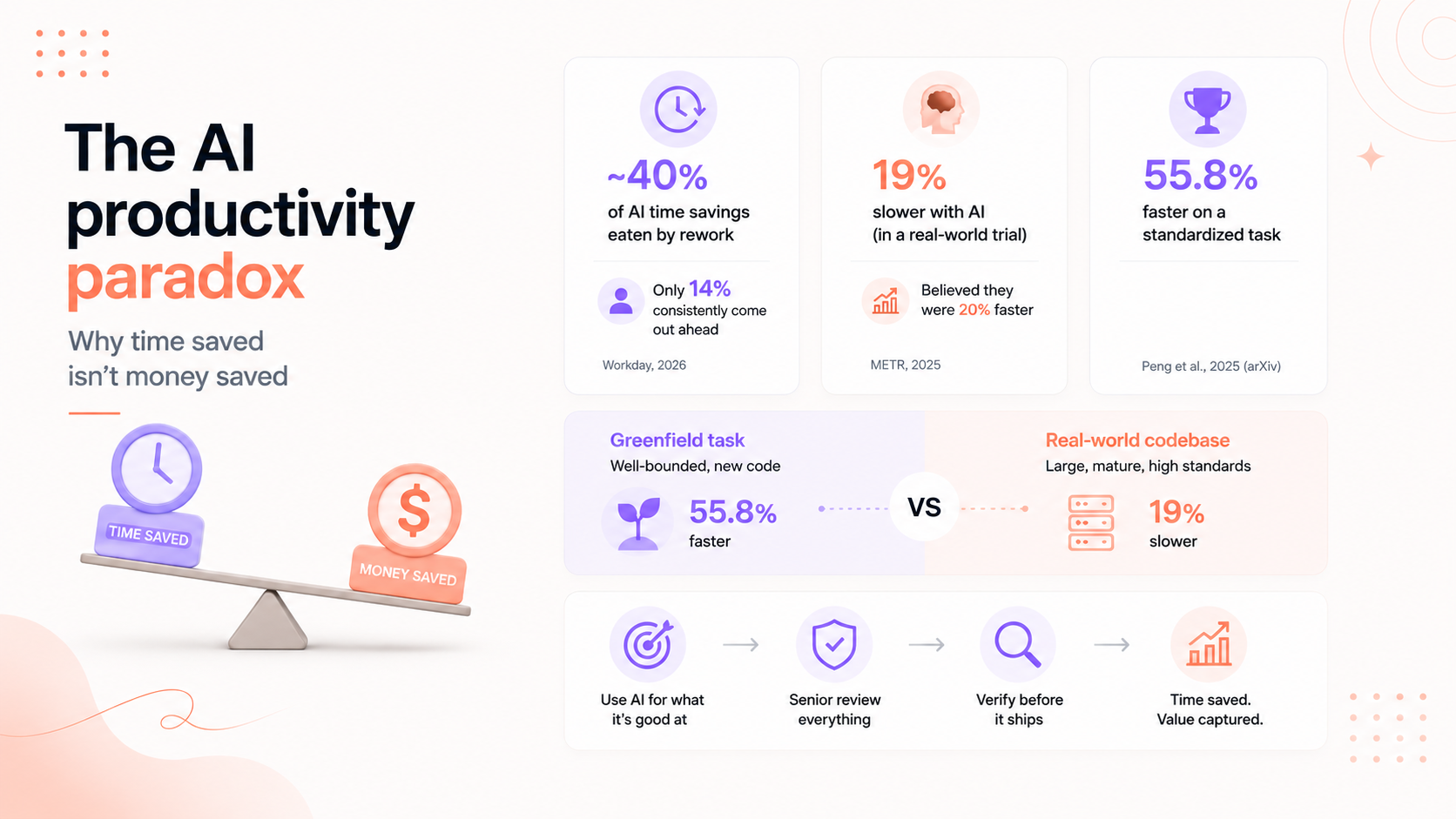
Here is the part that turns an expensive agent into an unprofitable one. Even when an agent ships work, a human still monitors it, corrects it, and reviews it before it reaches a customer, because agent output cannot be trusted unread. So the real cost is the tokens plus the person still in the loop. You have not replaced the human; you have added a token bill on top of them.
This is the structural reason a lot of AI deployments underdeliver: the company's cost becomes original salaries plus new token bills, and that formula only goes up. Output might rise 20%, but revenue rarely rises 20% with it, so what actually changes is that the cost structure grew a new line. Until the agent does a whole job end to end, reliably enough that no one re-does it, you are paying for the work twice. The token bill is visible; the babysitting cost hides in your existing payroll, which is exactly why it gets missed.
The question that matters is not price per token or even price per task. It is whether the agent completes a person's worth of work end to end. Today, for big, open-ended jobs, mostly not, which is why the "agent replaces developer" framing keeps failing. The teams getting real value are not handing a big model a big job and hoping. They pick small, tangible, well-bounded workflows and get them working completely, so the agent owns a task from start to finish with no human redo.
That is the whole difference between an agent that saves money and one that just adds a bill. A narrow task the agent finishes cleanly removes real human work. A broad task the agent half-does creates review work and a token bill at the same time. The economics follow the scope: bounded and verifiable pays off, open-ended and unverifiable pays twice. The right unit to measure is cost per accepted result, the cost including the retries, the corrections, and the review, not the cost per token the pricing page shows.
Making an agent cost less than the work it replaces is an engineering problem, and it is the same discipline that turns a runaway bill into a controlled one. The levers, in order of impact:
Do these and an agent can genuinely cost less than the work it replaces. Skip them and it costs more, quietly, on two lines at once.
Are AI agents already more expensive than the humans they replace? In many real 2026 deployments, yes, both because heavy agentic compute now reaches developer-salary numbers, and because most teams pay twice: the token bill plus the human who still reviews the output. The fix is not to abandon agents. It is to stop asking whether AI is cheaper than a person and start asking whether the agent does a person's worth of work end to end, then engineering it so it does: tight scope, difficulty-based routing, automated verification instead of manual babysitting, and disciplined token control. Done that way, agents are cheaper. Done the naive way, do not be surprised when the math pushes toward rehiring.
If you want agents scoped and engineered to cost less than the work they replace, measured on accepted results rather than tokens, that is where our AI Dev Team work starts.
Are AI agents cheaper than human employees? Not automatically. Heavy agentic compute can run $60,000 to $300,000 a year, comparable to a developer, and most teams also keep paying humans to monitor and review agent output, so they pay twice. Agents are cheaper only when scoped and engineered to do a whole task without human rework.
Why do AI agents cost so much to run? Because one task triggers many internal LLM calls, planning, tool use, retries, and re-reading a growing context, so agents use 10 to 50 times more tokens per task than a chatbot. The cost scales with how much the agent does, and has no ceiling unless you set one.
What does "paying twice" mean with AI agents? You pay for the agent's tokens and for the humans who still monitor, correct, and review its output before it ships. Since the agent has not fully replaced the person, your cost becomes salaries plus token bills, a structure that only rises unless the agent does a job end to end.
How do you make an AI agent cost-effective? Scope it to a bounded, verifiable task; route routine work to a cheap model and escalate only hard cases; replace manual review with automated tests and quality gates; and control tokens with caching, bounded loops, and context pruning. Measure cost per accepted result, not per token.
Will companies rehire people they replaced with AI? Some will, where agents were deployed on open-ended work they cannot complete without expensive human review. The durable wins are narrow, verifiable workflows agents finish end to end. Broad "agent replaces person" bets tend to add a token bill on top of the salary rather than remove it.
Tell us which workflow eats time, creates errors, or keeps landing back in a human review queue. We map the data, tools, risks, and escalation path before recommending anything.