Konstantin Semenenko
June 20, 2026
5
minutes read
Vibe coding is building software by describing what you want to an AI tool and shipping whatever it produces, without owning the architecture underneath. It breaks in production because the AI optimizes for code that runs now, not for a system that holds up.




Vibe coding gets you a working screen in an afternoon. It also gets a lot of teams stuck three months later, when the app that demoed beautifully cannot survive real users. Here is what vibe coding actually is, why it breaks in production, and how to keep the speed without the wall.
Vibe coding is building software by describing what you want to an AI tool and shipping whatever it produces, without owning the architecture underneath. It is fast and genuinely useful for prototypes. It breaks in production because the AI optimizes for code that runs now, not for a system that holds up under load, edge cases, and change.
We see this from the cleanup side. A common starting point for our projects is rescuing a vibe-coded app that hit a production wall, so this is written from the rescues, not from theory.
Vibe coding is prompt-driven development: you tell an AI assistant what you want, it writes the code, you run it, and you move on if it works. You are steering by the result on screen, not by the structure behind it.
For a prototype, this is great. You validate an idea in days instead of weeks, and you do not need to be an engineer to get something on screen. The trouble starts when the prototype gets treated as the product. Vibe coding is fast because it skips the parts that make software durable, and those parts are exactly what production needs.
A demo runs once, with clean input, on the happy path, for one friendly user. Production runs constantly, with messy input, on every path, for users who do unexpected things at the worst time.
AI-generated code is tuned for the first case. It produces something that satisfies the prompt, which usually means the visible behavior is correct. What it rarely produces on its own is the invisible scaffolding: consistent data models, error handling, security boundaries, tests, and an architecture that lets the next change happen without breaking the last one. The model works. The integration doesn't.
From the rescues, the failure list is consistent:
The pattern underneath all of it: vibe-coded apps have no architecture to defend, so each fix creates the next bug.
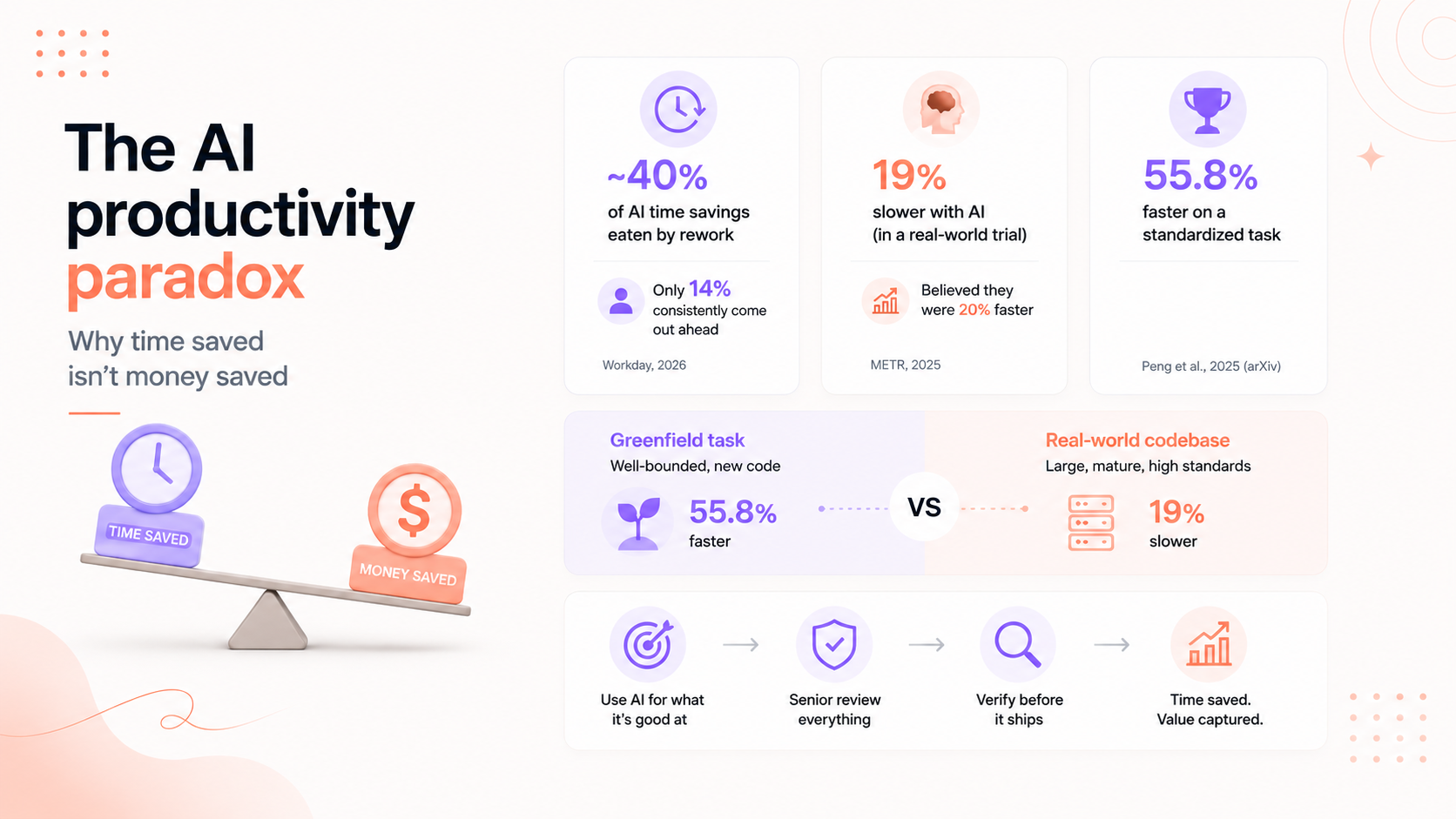
Yes, but the AI has to be accountable to rules, not just prompts. The speed of AI coding is real and worth keeping. The fix is not to slow down; it is to put a structure around the agent so what it generates fits a system instead of floating free.
That is why our open-source framework MCAF is skill-first: it gives agents AGENTS.md, repository-native skills, and automated verification, so the code an agent writes matches the codebase and passes real checks before anyone trusts it. An internal quality framework then reviews AI-generated code against architecture rules and test coverage before it ships. The agent stays fast. The gate keeps it honest.
The hard part of building with AI isn't generating code. It's deciding what is allowed to ship.
We start with discovery, not a rewrite. The first move is to map what the product does, where the real risks are, and which parts are worth keeping. Some vibe-coded work is fine and can stay; the goal is to find the load-bearing problems, not to throw everything away on principle.
From there it is an incremental rebuild behind a stable surface: harden the data model, put auth and validation in place, add the missing states, cover the critical paths with tests, and replace the fragile pieces one at a time while the app keeps running. You do not take the product offline to fix it.
If you are prototyping, keep doing it, and set a line in advance. Use vibe coding to find out whether an idea is worth building, then treat the prototype as a throwaway, not a foundation. Before real users or real money touch it, get an engineer to own the architecture, the data model, and the security boundary. The cheapest time to bring in that judgment is before the wall, not after.
If your no-code or vibe-coded MVP is already slowing down, breaking on edge cases, or scaring you every time you ship, that is the signal. AI Discovery is the usual first step: it turns the mess into a clear decision about what to keep, what to rebuild, and in what order.