Konstantin Semenenko
June 24, 2026
6
minutes read
Take the hours your team spends each week on repetitive manual tasks, multiply by their loaded hourly cost, and annualize it. If two people spend most of their week on manual routine, that's roughly $40,000 to $100,000 a year, and automating it usually pays back in under a year.




Most businesses know manual work is a drain, but few have put a number on it. Once you do, the case for automating it gets concrete fast. Here's how to calculate what repetitive manual work actually costs you, with real figures, and how the same work compares by hand versus with AI.
The quick version: take the hours your team spends each week on repetitive manual tasks, multiply by their loaded hourly cost, and annualize it. If two people spend most of their week on manual routine, that's roughly $40,000 to $100,000 a year, and automating it usually pays back in under a year.
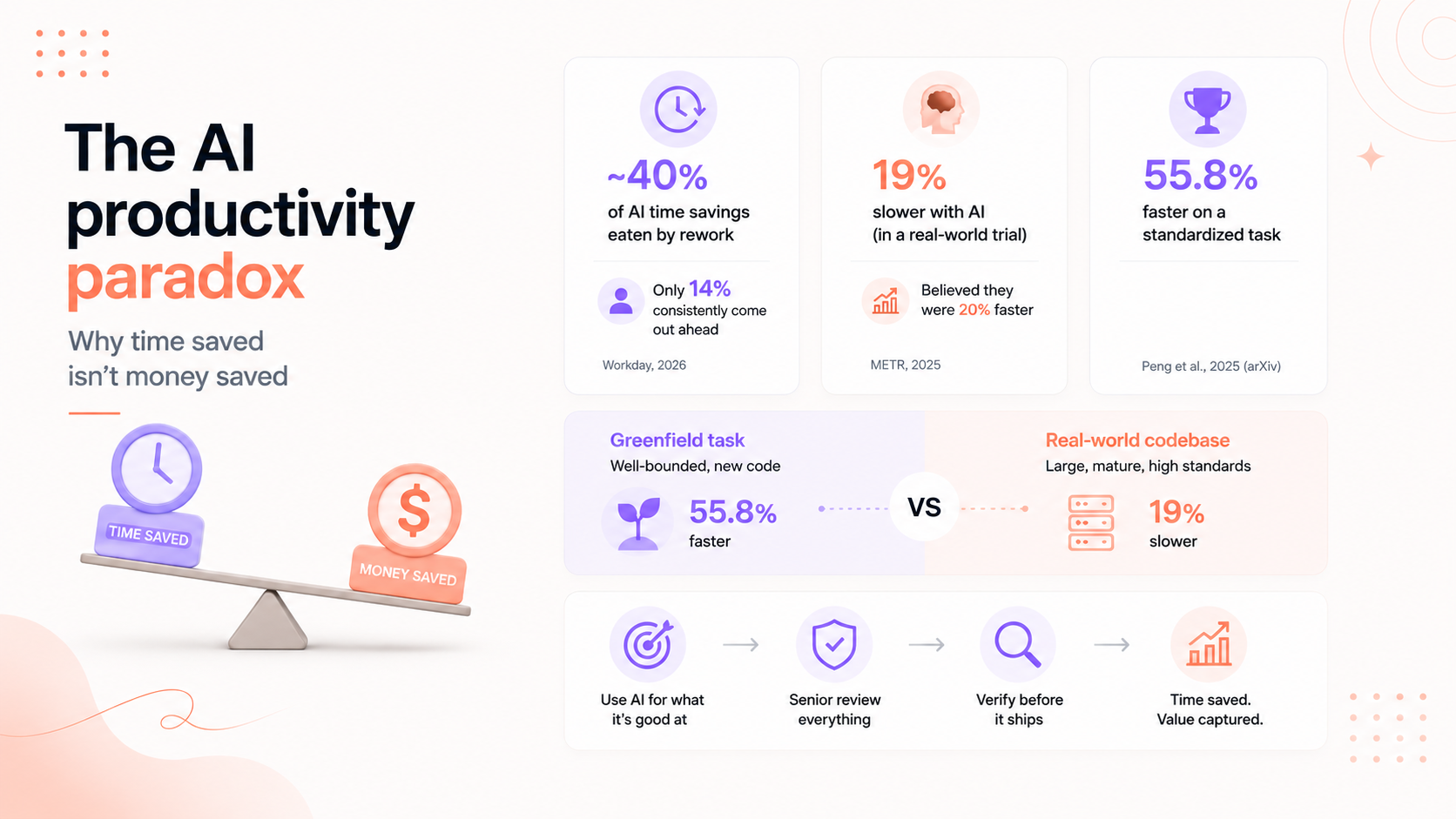
The clearest way to see the cost is to compare the same task done manually and done with AI. These are hard numbers from controlled studies and named research, not estimates.
The two coding and customer-support figures come from controlled experiments (Peng et al., Cornell; Brynjolfsson, Li & Raymond, NBER), so they measure cause, not correlation. AI doesn't shave a few percent off the work it fits, it roughly halves the time or lifts output by double digits.
Bigger than it looks, because the cost hides in small daily increments. A Smartsheet survey found 83% of knowledge workers say they spend too much time on manual data entry that could be automated. Any single task feels minor; the weekly total per person is large.
Three numbers: hours, rate, and error. Multiply weekly hours per task by the loaded hourly cost of the people doing it, then annualize. Then add the cost of mistakes, because manual entry has a measurable error rate documented in academic research.
Run your own volumes through hours, rate, and error, and the "cheap" manual workflow usually turns into one of your biggest hidden costs.
Far more than the entry itself, because errors get more expensive the longer they live. A 2025 study reported by IBM found that over a quarter of organizations estimate they lose more than $5 million a year to poor data quality, and 7% put their losses at $25 million or more. The reason it's so costly is timing: a bad record rarely fails at the point of entry, it surfaces downstream as a wrong decision, which is exactly why catching it at the source is worth so much.
Roughly a person and a half of manual work. If repetitive tasks consume the equivalent of 1.5 to 2 full-time people, that's $40,000 to $100,000 a year, and a custom automation typically pays for itself inside twelve months. Below that threshold, an off-the-shelf tool is usually fine, and we'll tell you so. The point isn't to automate everything, it's to automate where the money actually leaks.
You measure it, then you model it. That's what a Discovery is: we map your actual process, count the hours and the error cost, and hand back a number plus a plan for what to automate first and the ROI on it, before any build. If the math doesn't work, you keep the report and we part as friends. That's AI Discovery, and if you're weighing who should build the automation once the numbers check out, start with who should build your MVP.
Tell us which workflow eats time, creates errors, or keeps landing back in a human review queue. We map the data, tools, risks, and escalation path before recommending anything.