Alina Kostiuk
June 30, 2026
3
minutes read
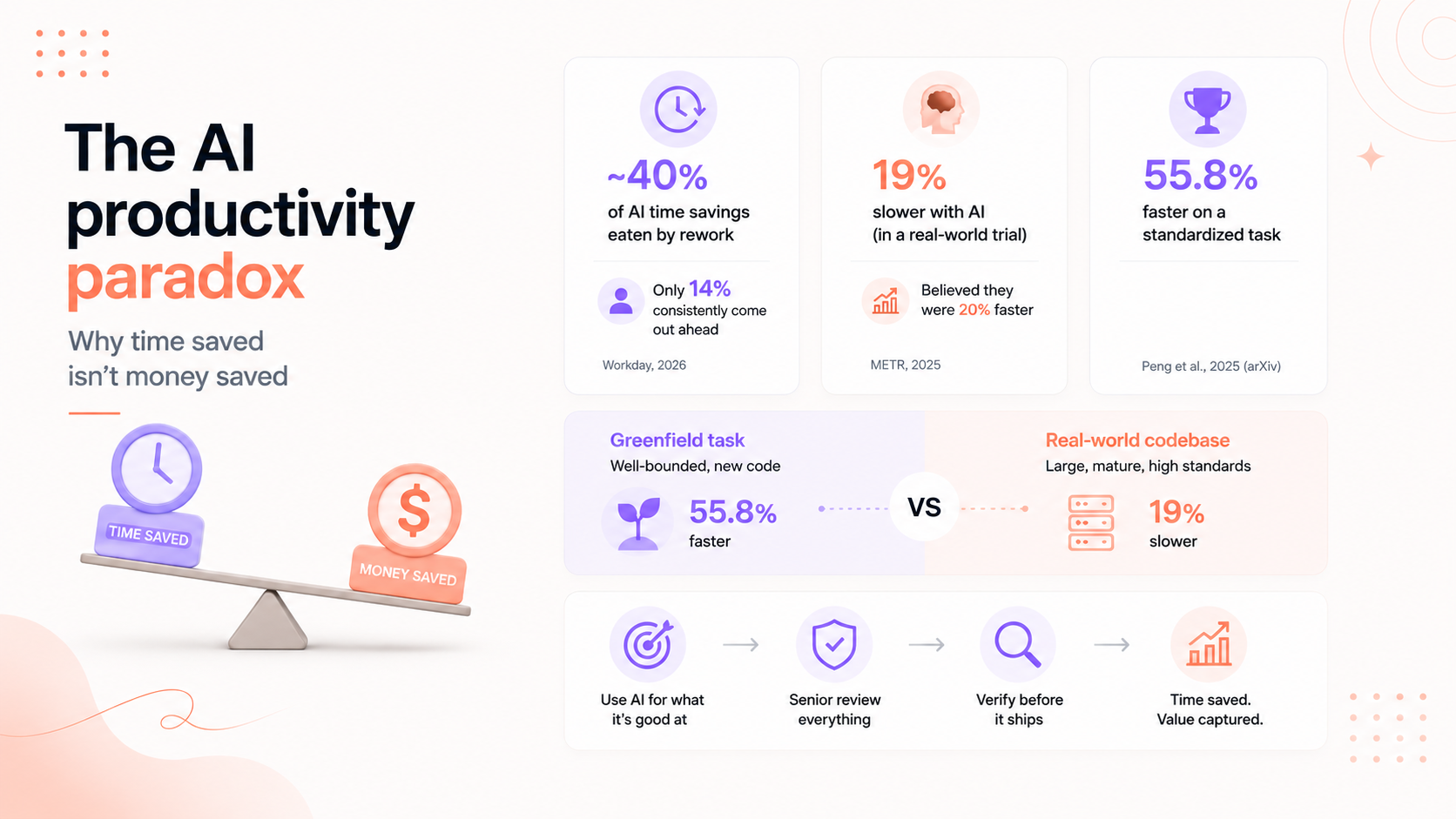
AI replaces the first 70% of a Webflow build, the layout and the boilerplate, and leaves the 30% that decides whether the site ships: CMS architecture, responsive integrity, accessibility, performance, and edits that don't break the page. For a marketing site AI plus a developer beats either alone.




AI does not replace a Webflow developer, but it does replace most of the typing. It generates a layout, fills sections, and gets you a page that looks done in minutes. What it can't do is the part a Webflow developer is actually paid for: structure the CMS so content scales, make the page survive real copy and real devices, pass an accessibility and performance bar, and build it so a non-technical team can edit it without breaking the layout. So the honest answer for an enterprise team is that AI changes the job, it doesn't remove it. The developer stops doing the boilerplate and spends the time on the 30% that decides whether the site ships.
We build Webflow sites for enterprise clients, and this question comes up in nearly every kickoff now. This is the evaluation we actually give, broken down by what AI genuinely handles and what still needs a person.
The generation layer is real, and pretending otherwise helps no one. AI takes you most of the way from a prompt or a Figma file to a Webflow page: it produces a responsive multi-section layout, drafts copy and placeholder structure, applies a foundational design system, and gets a believable page on screen fast. For a first draft, exploration, or a simple landing page, that's genuine time saved.
This is the part that makes people ask the replacement question. If AI can produce a page that looks finished, why pay for a developer at all? The answer is in the word "looks." The output is a strong starting point, and a starting point is not a shipped site. The gap between them is exactly the work AI skips, and on an enterprise site that gap is most of the cost.
The first thing AI doesn't do is structure your content. An enterprise Webflow site is not a static page, it's a CMS: collections, fields, references, dynamic pages, the difference between what's hard-coded and what an editor controls. AI generates a page that looks like content. It rarely designs the model underneath that content, because that model depends on how your business actually publishes, updates, and reuses information.
Get this wrong and the site is built twice: once to get it on screen, and again to retrofit a CMS when the marketing team needs to add the eleventh case study and there's nowhere to put it. A Webflow developer designs the content model first, so the page is assembly on top of a real structure. That decision is invisible in the mock and decisive in production.
The second gap is responsiveness that holds. AI typically nails the breakpoint it generated for and improvises the rest, so desktop looks right while tablet and mobile show overlapping elements, broken spacing, and text that no longer fits. On enterprise traffic that's not a minor flaw, because a large share of decision-makers first see the page on a phone.
Real responsive behavior is a system property: consistent spacing rules, a true type scale, components that know how to reflow. A developer builds those constraints so the layout survives any width and any content length. AI guesses per screen. The difference shows the moment the page meets a device the generation pass didn't consider.
The third gap is the one that turns into a procurement or legal problem. AI design-to-code output is often a flat tree of generic containers: no real heading hierarchy, buttons that are styled divs, images without alt text, focus order that makes no sense to a keyboard user. For a consumer landing page that's sloppy. For an enterprise buyer with accessibility requirements, it's a blocker.
Performance sits in the same place. A generated page can carry heavy assets, unoptimized images, and animation that tanks the load time, none of which the mock reveals. A Webflow developer builds to an accessibility standard and a performance budget, because enterprise sign-off depends on both. AI has no concept of either unless a person enforces it.
The fourth gap is what happens after launch. The real test of a Webflow build is whether a non-technical marketer can change the hero text, swap an image, or add a CMS item without the layout falling apart. AI-generated structure is often a one-off: it works in the state it was generated, then a routine edit reopens the whole build because nothing was made to be edited.
This is the quiet cost that shows up months later. A developer builds with clean classes, reusable components, and a content model so edits are safe by design. That's the difference between a site the team owns and a site that needs a developer every time the copy changes. AI optimizes for the page looking right once. A developer optimizes for it staying right.
The useful framing is not human versus AI, it's where each one wins. AI is the fastest first-draft tool Webflow work has ever had: use it for exploration, layout directions, boilerplate, and the believable starting page. The developer takes that draft and does the part that ships it: the CMS model, the responsive system, the accessibility and performance bar, and the editable structure.
That division is why AI plus a developer beats either alone. AI alone gives you a page that looks done and breaks under real use. A developer alone is slower than they need to be on the parts AI handles fine. Together, the developer's judgment covers far more ground, because the machine absorbs the boilerplate and the person spends the saved time on the decisions that matter. We wrote about the same split for design in why AI websites all look the same: generation is the draft, judgment is the product.
AI cannot replace a Webflow developer for an enterprise site, because the value of the developer was never the typing. It's the CMS architecture, the responsive system, the accessibility and performance bar, and the editable structure, all the parts that decide whether a page survives real content, real devices, and real edits. AI makes those decisions faster to act on by handling everything around them. It does not make them for you.
The pattern holds across all AI building: the model produces the draft, and the system that finishes it is the product. If you want an enterprise Webflow site built this way, AI for speed and a senior developer for the parts that ship, that's where our Webflow development work starts.
Tell us which workflow eats time, creates errors, or keeps landing back in a human review queue. We map the data, tools, risks, and escalation path before recommending anything.