Konstantin Semenenko
June 26, 2026
4
minutes read
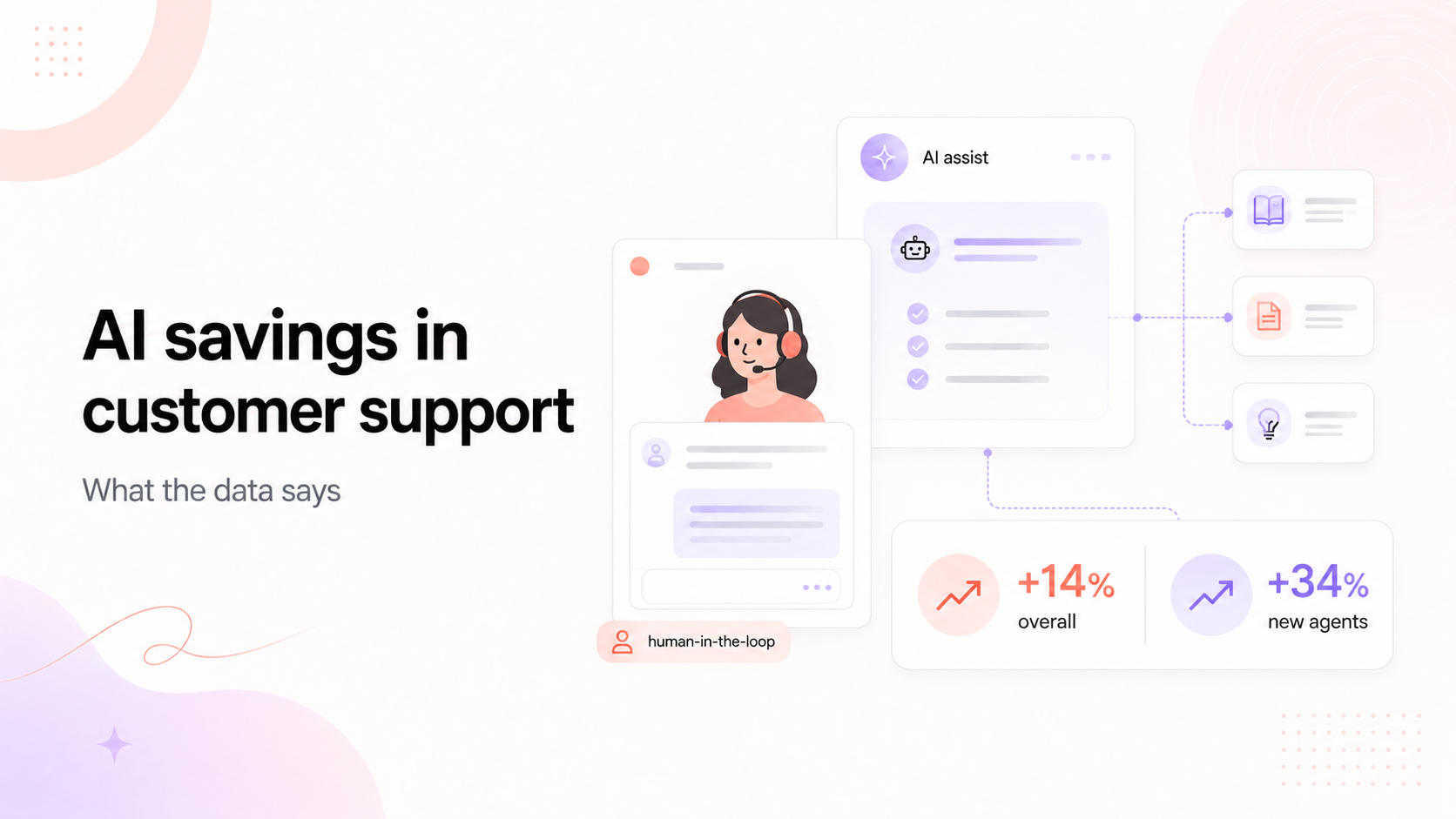
A support bot grounded in your own data resolves repeat questions on its own and escalates the hard cases with full context, which lowers your team's ticket load and speeds up answers. A generic scripted chatbot does the opposite: it deflects, frustrates, and creates more work.




Most support bots fail for the same reason: they're generic. They answer from a thin script, can't see your data, and hand anything difficult to a human with no context. A support bot worth having answers from your own knowledge base, writes notes back to your CRM or helpdesk, and escalates real cases with the full thread attached. The outcome is a lower support load, faster answers, and fewer tickets reaching your team at all.
We build support automation that sits behind your team, not in front of your customer as a wall, so this is from running it in production.
It knows your business and knows its limits. A useful bot answers from your actual policies, products, and history, resolves the repetitive questions on its own, and hands off cleanly when it can't help. The difference comes down to grounding and escalation, not how clever the chat sounds.
Because they don't know anything specific. A bot running on a handful of canned answers can't tell a customer their order status, their plan details, or the fix for their exact error, so it deflects and frustrates. The cost then moves from answering to apologizing, as your team cleans up after the bot. A support bot that doesn't know your business is just a slower FAQ page.
By reading your own knowledge. The bot connects to your documents, help articles, and records through retrieval, so when a customer asks something, it pulls the relevant facts from your material and answers from those. On one eCommerce project, we grounded the bot in the store's own product, order, and policy data. It resolved the repeat questions, returns, order status, sizing, on its own, and cut the team's manual operations by around 60%. The hard cases still reached a person, but with the full thread attached.
The bot hands a person the whole case, not a cold start. When something needs a human, a judgment call, an upset customer, anything outside its knowledge, it routes the ticket to the right queue with the full conversation, the customer's details, and what it already tried. The agent picks up mid-context instead of asking the customer to start over, which is the moment most support experiences fall apart.
Ground it, bound it, and watch it. Ground every answer in your own content so it isn't inventing, bound it to escalate when confidence is low, and review what it says in the early weeks to catch gaps. A bot that honestly says "let me get a person" beats one that confidently says something wrong.
Pull your ten most common tickets, connect the bot to the documents that answer them, and let it handle just those while everything else escalates. Measure deflection and customer satisfaction, then widen its scope. We build this as part of your AI Dev Team. For regulated data that can't leave your walls, the same bot runs on a private model, which we cover in running AI agents privately.
Tell us which workflow eats time, creates errors, or keeps landing back in a human review queue. We map the data, tools, risks, and escalation path before recommending anything.